
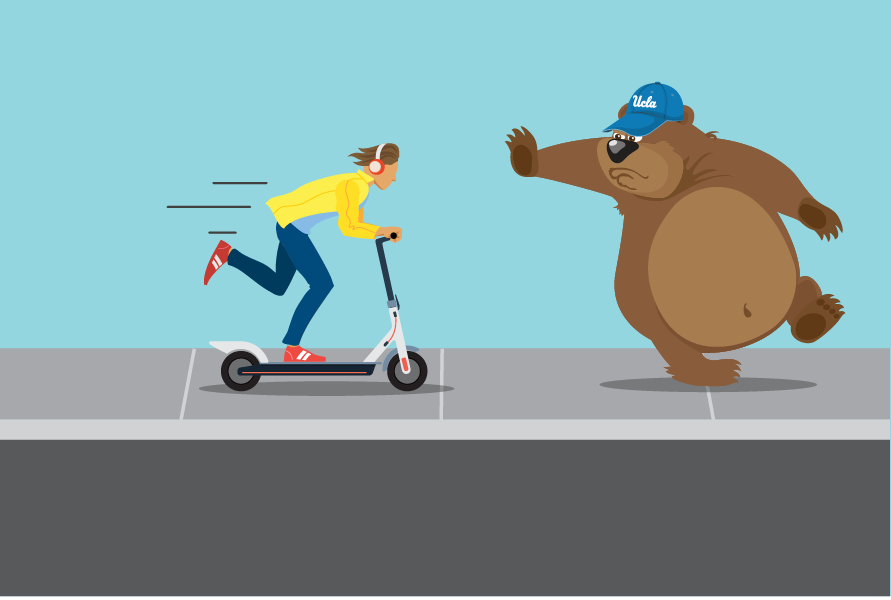
A moving violation could result in points against your driving record.
Definition CVC 407.5(a)
A “motorized scooter” is a vehicle that:
- Has handlebars and two wheels
- Runs on an electric motor
- Has a floorboard for standing on OR a seat with footrests
- May also be powered by human propulsion
License Required CVC 21235(d)
Operators must have a valid driver’s license or instruction permit.
Follow Traffic Laws CVC 21221
E-scooter riders have the same rights and responsibilities as motorists. Riders must:
- Yield to pedestrians
- Obey traffic signs and signals
- Stop at stop signs
- Follow the direction of traffic
Speed Limit: Always a MAX of 15 mph CVC 22411
The speed limit is always a MAX of 15 mph, even if the posted limit is higher.
Safety Rules CVC 21221.5, CVC 21235, CVC 27400
- No sidewalk riding except as may be necessary to enter or leave adjacent property
- Ride on campus permitted pathways and observe the dismount zones
- Always keep at least one hand on the handlebars
- Park scooters upright and away from the path of travel
- One rider per scooter (no passengers)
- Keep handlebars at or below shoulder level
- Do not hold onto or attach to another vehicle
- Headphones or earplugs should not be worn in both ears (hearing aids allowed)
- Must not ride while under the influence of alcohol or any drug
- Helmets required for riders under 18
- UCLA employees riding on campus are required to wear a helmet (UCLA Policy 605)
Where to Ride CVC 21228, CVC 21229, CVC 21235(b)
- No riding on streets with a speed limit above 25 mph, unless in a Class II or IV bikeway
- Stay near the right curb or in a bike lane when available
- Leave the bike lane only to pass safely, make a left turn (two-way streets), make a right turn (one-way streets), avoid hazards, or approach a legal right turn
- Signal before leaving the lane (Chapter 6 Vehicle Code)
- No sidewalk riding except as may be necessary to enter or leave adjacent property
- Ride on campus permitted pathways and observe the dismount zones
Turning CVC 21228
Left turn on a two-way street or a right turn on a one-way street:
- Stop, dismount, and walk the scooter across the crosswalk
Equipment CVC 21227, CVC 21235(a), CVC 21223
Brakes Required
- Motor must disengage when brakes are applied
Lights and Reflectors Required at Night
- White front light visible from 300 ft
- Red rear reflector visible from 500 ft
- White or yellow side reflectors visible from 200 ft
Reference
This summary is for general informational purposes. For details on current laws, please refer to the Rules of the Road for the Operation of Motorized Scooters.
Definition: Bicycle CVC 231
A riding device that has one or more wheels and is propelled exclusively by human power through a belt, chain, or gears.
California Vehicle Codes for the Operation of Bicycles [21200-21213]
Definition: Electrically Motorized Board (E-Skateboard) CVC 313.5
A wheeled device that:
- Has a floorboard designed to be stood upon while riding
- Is designed to transport only one person
- Measures no more than 60 inches in length and 18 inches in width
- Is powered by an electric motor less than 1,000 watts
- Has a top speed of 20 mph or less on a paved, leveled surfaces
- May also be powered by human propulsion
California Vehicle Codes for the Operation of Electrically Motorized Boards [21290-21296]
Definition: Electric Bicycle CVC 312.5
A bicycle with fully operable pedals and an electric motor that does not exceed 750 watts of power.
- Class 1: Provides assistance only while the rider is pedaling and ceases to provide assistance at 20 mph
- Class 2: Operates via pedal-assist or throttle and ceases to provide assistance at 20 mph
- Class 3: Provides assistance only while the rider is pedaling and ceases to provide assistance at 28 mph
California Vehicle Codes for the Operation of Bicycles [21200-21213]
Definition: Shared Mobility Device CVC 554
A shared mobility device refers to a personal transportation device such as a motorized scooter, motorized bicycle, bicycle, or similar vehicle made available to the public for shared use through a digital platform for a fee.
UCLA currently has a partnership with Bird and Veo to offer shared micromobility services on campus.
Lithium-ion batteries in e-mobility devices can catch on fire or explode if used incorrectly, damaged, or installed in devices that haven’t been tested to established safety standards. Follow the tips below to keep yourself and others safe.
Storage:
- Always read and follow the manufacturer’s storage instructions.
- Store batteries and devices at room temperature. Don't leave them in a hot car, in direct sunlight, near heat sources, or in freezing temperatures.
- Do not leave your device charging on flammable surfaces. Keep your device away from combustible materials.
- Avoid exposing your battery and device to a lot of moisture.
Charging:
- Always read and follow the manufacturer’s charging instructions.
- Do not charge your device unattended or overnight. Only charge when you are present. If you need to leave, unplug your device.
- Do not charge or leave your device near exits or points of egress, including bedroom doors, windows, and stairways. Always keep these routes clear so you can escape and emergency personnel can enter.
- Turn off your device while it is charging.
- Avoid overcharging and charge in a well-ventilated area.
- Wait at least 30 minutes after riding before charging to prevent overheating.
- Plug your charger directly into a wall outlet (do not use an extension cord or power strip).
Use:
- Always read and follow the manufacturer’s instructions for use.
- Only use the battery and charger that were designed for and came with your device. If you need a replacement, use one from the same manufacturer. Avoid third-party alternatives and other incompatible chargers.
- Have repairs performed by a qualified professional.
Discontinue use immediately if:
- You notice any odors
- There are any changes in shape or color
- There is any leaking or odd noises
If a fire breaks out, leave the area immediately and call 911. Do not attempt to put the fire out yourself.
Battery Disposal:
- Do not put lithium ion batteries in the trash or regular recycling bins.
- Take batteries to a designated battery recycling location or contact your local waste department for proper disposal instructions.
- Intact or discarded batteries must never be stored in dense piles, as this creates a severe thermal runaway and fire hazard.
Resources:
Park your device at any designated scooter parking or bike parking location. Do not block walkways, ADA pathways, or stairs. Improperly parked devices may be relocated, immobilized in place, or impounded.
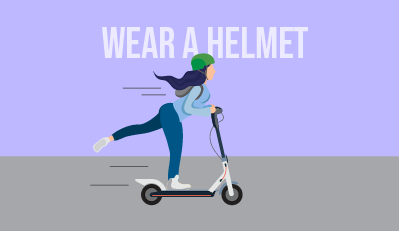
Helmets can save your life. Pick up a free helmet at the UCLA Bike Shop located at the John Wooden Center
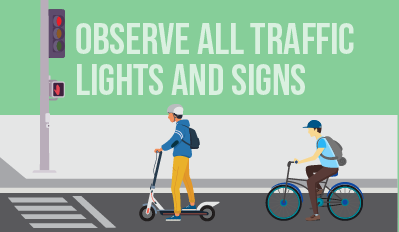
Ride on the street or on campus permitted pathways
Stay off sidewalks and out of crosswalks
Yield to pedestrians
Do not speed (15 mph or below at all times)
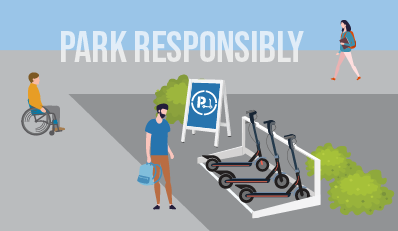
Devices should be parked at designated scooter parking or bike parking locations
Don't block walkways, ADA pathways, or stairs
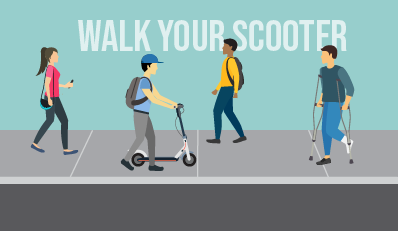
Walk your device in the dismount zone
View more safety tips from the Consumer Product Safety Commission.